Monday, May 13, 2013

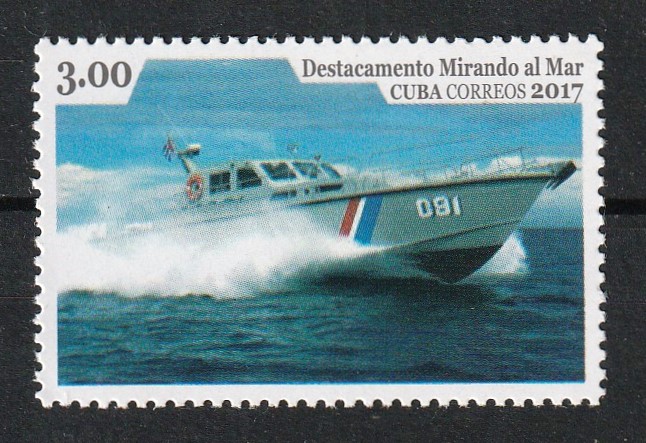
Indian Coast Guard Ship Ahalyabai - Silver Jubilee

Date of Issue: September 09, 2012

Indian Coast Guard Ship Ahalyabai named after the Queen of Maheshwar, celebrated the 25th anniversary of its service to the nation on September 09, 2012.

The ship, like the great queen, has protected the vast coastline of the Indian subcontinent, in addition to its Coast Guard charter of duties, like search and rescue and pollution control.

In a fitting tribute to the ship, a special cover and a photo journal depicting the operations of Ahalyabai were released by the Chief Guest, Inspector General SP Sharma, Commander Coast Guard Region (East), at a grand ceremony at the VOC Port, Thoothukudi (Tuticorin), in the presence of the Post Master General (PMG) Kulbir Singh and other civil dignitaries.

The 44.9-meter-long Indian Coast Guard Ship was commissioned in Singapore on September 9, 1987 under the reins of the then Deputy Commandant SPS Basra.

Over the last 25 years, 19 commanding officers have been at its helm, and the ship has sailed more than 3 lakh nautical miles covering the Indian EEZ, resulting in the seizure of gold worth half a billion rupees and contraband worth 30 million. Over the last 25 years, the ship has operated from three different base ports -- Haldia, Mumbai and Thoothukudi.  The PMG said that this is the first time that a special cover is being released to commemorate the Silver Jubilee anniversary of a ship.


Source: NewIndianExpress - 10.09.2012

Thursday, May 9, 2013

150 Years of Red Cross - Postmark - Germany - DRK-Hilfsschiff MS Flora

Date of Issue: Apr 06, 2013

A special postmark was introduced at Kiel, Germany by Deutsche Post, to commemorate 150 Years of Red
Cross. The World Red Cross Day is celebrated on May 8th - Birth date of Henry Dunant - a Swiss businessman and social activist, who on 1863 founded the International Committee of the Red Cross (ICRC). This year, 2013 marks the 150 Years of the foundation of Red Cross. This special postmark shows the German Red Cross Auxiliary Ship - MS Flora.

MS Flora: Built in 1966, MS Flora was acquired by the German Red Cross in the year 1979.  The ship was equipped for the transportation of supplies and disposal of medical aid locally using a board hospital with operating room , in which the Sisters of the Red Cross sororities were used. The hospital board
was mainly used for outpatient treatment, inpatient treatment but were also possible.

In order to bring relief without existing infrastructure on land, the ship possessed a motorized pontoon landing ( Flori starlet ), with the help of three ship cranes could be loaded. The pontoon was on the front hatch cover carried.

Thanks to friend, Mr. Wolfgang Beyer from Germany for sending me this cover to add in my collection.

Source: Wikipedia

Sunday, May 5, 2013

Indian Naval Signal School, Kochi - 50 Glorious Years (1958 - 2008)

Date of Issue: March 08, 2008

The Department of Posts, Kerala Circle issued special cover to commemorate 50 Years of Indian Naval Signal School, Kochi.

The crest depicts two crossed hand flags and radio waves, to show Visual Signalling and Wireless Communication.  The motto in Sanskrit reads 'Yunjan Chakshu, Shrotram Manaha' meaning 'Open your Eyes, Ears, and Mind."

The  first signal school was established as a temporary establishment, at Carnac Bunder in 1919. It was converted into a permanent establishment in 1920 inside Naval Dockyard. In 1939, the school was commissioned as HMIS Talwar and was relocated to a permanent building in Colaba which is now the MT Pool.  The school was shifted to Cochin in August 1946. During the years that followed the signal school was housed successfully in several temporary buildings around the present Command Parade Ground.

The role of signal school is to develop highly qualified personnel with requisite expertise in Naval Communication, Electronic Warfare, and Information Warfare by keeping abreast of changing technological environment with sound technical knowledge and professional acumen so as to optimally exploit the naval communication, electronic warfare equipment, procedures, and network enabled information structure.

 Source:  indiannavy.nic.in

Wednesday, April 17, 2013

Greek Cruiser Georgios Averof, 100 Years of Liberation of Thessaloniki

 Date of Issue: October 26, 2012

Hellenic Post issued set of 4 stamps to commemorate 100 years of Liberation of Thessaloniki on October 26, 2012. One of the stamp, 0,85 Euros depicts the Pisa-Class armored cruiser Georgios Averof and other ships, which participated in the First Balkan War (October 2012 - May 2013).

Georgios Averof  is a Greek warship which served as the flagship of the Royal Hellenic Navy during most of the first half of the 20th Century. Although popularly known as a battleship, it is in fact an armored cruiser,  the only one of its type worldwide still in existence.

With the outbreak of the First Balkan War, Kountouriotis was named Rear Admiral and Commander-in-Chief of the Hellenic Royal Navy. Averof, under Captain Sofoklis Dousmanis, served as the flagship of the fleet, and she took part in the takeover of the islands of the northern and eastern Aegean. During the naval battles at Elli (December 3, 1912) and Lemnos (January 5, 1913) against the Ottoman Navy, she almost single-handedly secured victory and the undisputed control of the Aegean Sea for Greece. In both battles, due to her superior speed, armor and armament, she left the battle line and pursued the Turkish Fleet alone. During the Battle of Elli, Kountouriotis, frustrated by the slow speed of the three older Greek battleships, hoisted the Flag Signal for the letter Z which stood for "Independent Action", and sailed forward alone, with a speed of 20 knots against the Turkish fleet. Averof succeeded in crossing the Turkish fleet's "T" and concentrated her fire against the Ottoman flagship, thus forcing the Ottoman fleet to retreat in disorder. Likewise, during the Battle of Lemnos, when the older battleships failed to follow up with Averof, Kountouriotis did not hesitate to pursue independent action.

During both battles, the ship suffered only slight damage, while inflicting severe damage to several Turkish ships. These exploits propelled the ship and her Admiral to legendary status in Greece. After Lemnos, the crew of the Averof affectionately nicknamed her "Lucky Uncle George". It is a notable fact that, due to the aforementioned delays in the delivery of ammunition, Averof fired her guns for the first time during the Battle of Elli.

Many thanks to friend, Spyros Soulimiotis for sending this stamp on envelope addressed to me.

Click here to see Georgios Averof depicted in stamp of 1927.

Source: Wikipedia

Monday, April 15, 2013

360 years of Dutch Landing at the Cape, South Africa, portraying Krotoa

Date of Issue: September 06, 2012

360 years since the arrival of the Dutch at the Cape: portraying Krotoa

On 6 April 1652, Jan van Riebeeck, a commander in the Dutch East India Company (VOC) sailed into Table Bay with his fleet of two ships, the Drommedaris and the Reijger and the yacht Goede Hoop. Van Riebeeck was sent to the Cape from Amsterdam to establish a halfway station thatcould supply passing ships with fresh food and wine. A young Khoikhoi girl named Krotoa, also knows as Eva to the Dutch, who worked in the Van Riebeeckhousehold, became an important figure in South Africa's history.

To mark 360 years since the arrival of the Dutch at the Cape and to acknowledge the role played by Krotoa, the South African Post Office issued a miniature sheet with one stamp and a souvenir folder.

 The Dutch:  The VOC, one of the major European trading houses sailing the spice route to the East via the Cape of Good Hope, had no intention of colonizing the southern tip of Africa, instead wanting only to establish a secure base camp where passing ships could shelter, and where sailors could stock up on fresh supplies of meat, fruit, and vegetables.

While the new settlement traded out of necessity with the neighboring Khoikhoi, it was not a friendly relationship, and the company authorities made deliberate attempts to restrict contact. This prevented them from employing Khoikhoi, which resulted in a shortage of labor. To remedy the situation, the company released a small number of Dutch from their contracts and permitted them to establish farms, with which they would supply the VOC settlement from their harvests. They produced supplies of vegetables, wheat and fruit, especially citrus to prevent scurvy, and later also raised livestock.

The small initial group of free burghers, as these farmers were known, steadily increased in number and began to expand their farms further north and east into the territory of the Khoikhoi. Over time, the Khoikhoi, their European overseers, and slaves imported from Madagascar and Indonesia, mixed with the offspring of these unions forming the basis for South Africa's Colored population.

Krotoa: Born in about 1642, a decade before the arrival of Jan van Riebeeck, Krotoa was the first Khoikhoi woman to appear in the European (particularly the VOC) records of the early settlement at the Cape as an individual personality who interacted socially and culturally with the Dutch settlers.

Krotoa's brother-in-law is said to have been Oudasoa, a chief of the Cochoquas (also known as the Saldanhars). Jan van Riebeeck, who became the first governor of the Cape colony, employed her in his household.

As a teenager, Krotoa learned Dutch and Portuguese and like her uncle, Autshumao (known as Harry or Herrie by the Dutch) - a Goringhaicona Khoikhoi leader and trader, she worked as an interpreter for the Dutch who wanted to trade goods for cattle. Krotoa's role as interpreter extended beyond trading, as she was also instrumental in negotiating with the 'Peninsulars', whose foreman was Doman, regarding conflicts around land that erupted into formal war in1659.

Since Krotoa travelled frequently between the Dutch colony and the Cochoquas, she came to embody the notion of an in-between figure, but found little happiness in either community. On 3 May 1662, she was baptised into the Christian religion by a visiting parson, Petrus Sibelius, in the church inside the Fort de Goede Hoop.

On 26 April 1664, she married Pieter van Meerhoff, a Danish surgeon. She was the first Khoikhoi to marry according to Christian customs, and this marriage is the first between a European and a Khoi at the Cape. In May 1665, the couple left the Cape for Robben Island where Van Meerhoff became superintendent. He died on 27 February 1668 on an expedition to Madagascar.

On 30 September 1668, Krotoa returned to the mainland, with her children. According to VOC reports, she was suffering from alcoholism and left the Castle in the settlement to be with her family. In February 1669, she was imprisoned at the Castle and then banished to Robben Island for disorderly conduct. She returned to the mainland on many occasions just to find herself once more banished to Robben Island. Three of her children survived infancy. She died on 29 July 1674 at the Cape and was buried on 30 September in the church at the Fort.

Krotoa's eldest daughter, Pieternella, married Daniel Zaaijman, a friend of Van Riebeeck's. They lived in Madagascar for a while, but returned to the Cape upon the departure of the VOC from the island. Because of Pieternella's documented descendants, Krotoa is regarded a significant ancestor for many South Africans across various races.

The stamps: Designed by Lien Botha, the artwork features a drawing of Krotoa and a VOC ship from a painting by Aernhout Smit (1683). These images are superimposed onto a contemporary photograph taken at Milnerton beach with Table Mountain in the background.

The commemorative folder cover also features the face of Krotoa, this time encircled by a wreath of tulips, which alludes to the Company's Garden and the Dutch connection.

Source: postoffice.co.za

Monday, March 25, 2013

Capt. Cook's Return to England from 2nd Voyage

Date of Issue: August 08, 1975
Scott #:  433

Cook Islands issued a $2 stamp commemorating Bicentenary of Captain James Cook's return to England from his Second Voyage (1772 - 1775).

The stamp design shows obverse and reverse of a gold commemorative coin issued for this occasion, minted at Franklin Mint for Cook Islands.

The KM# is 13
Weight: 9.600 g
Denomination: $100
Mintage: 17,000
Metal: 0.900 fine gold
Obverse design: Captain James Cook, King George III, and HMS Resolution
Reverse design: Queen Elizabeth II

Sunday, March 24, 2013

Chinese Aircraft Carrier - LiaoNing (16)

Date of Issue: September 25, 2012

Special Cover Issued By: Navy Philatelic Research Society
Designer: Zi Yu
Cover Inscription: Zhai Ren He
Limited Edition: Serial No. HJF-117 of 1500 issued

LiaoNing (16) - This is the first aircraft carrier commissioned into the People's Liberation Army Navy (PLAN). Originally laid down as the Admiral Kuznetsov class multirole aircraft carrier Riga for the Soviet Navy, she was launched on December 4, 1988 and renamed Varyag in 1990. The stripped hulk was purchased in 1998 by the People's Republic of China and towed to Dalian Shipyard in north eastern China. After being completely rebuilt and sea trials, the ship was commissioned into the PLAN as Liaoning on September 25, 2012.

Text Source: Wikipedia

Monday, March 18, 2013

Kublai Khan and his Fleet

Date of Issue: March 04, 2012

This miniature stamp sheet of Mongolia shows the portrait of the Great Mongol Emperor of 12th Century, and the founder of Yuan Dynasty in China - Kublai Khan and a sailing warship of his period.

Kublai Khan twice attempted to invade Japan. It is believed that both attempts were thwarted by bad weather or a flaw in the design of ships that were based on river boats without keels, and his fleets were destroyed. The first attempt took place in year 1274, with a fleet of 900 ships. After the first Mongol attack on Japan, Japanese pirates known as Wokou raided Korea, but Mongol-Korean forces pushed them back, and the Wokou pirates decreased their activity due to the increased military preparedness of the Goryeo and the Kamakura. In 1293 the Yuan navy captured 100 Japanese people from Okinawa.

The second invasion occurred in year 1281 when Mongols sent two separate forces; 900 ships containing 40,000 Korean, Chinese, and Mongol troops were sent from Masan, while a force of 100,000 sailed from southern China in 3,500 ships, each close to 240 feet (73 m) long.

Kublai Khan also invaded Đại Việt (Vietnam) three times.

Three expeditions against Burma, in 1277, 1283 and 1287, brought the Mongol forces to the Irrawaddy Delta, whereupon they captured Bagan, the capital of the Pagan Kingdom in Burma, and established their government.

Text Source: Wikipedia

Sunday, March 17, 2013

Sacred Mayan Journey - Mayan Canoe

Date of Issue: December 21, 2012

Sacred Mayan Journey - The project of the Sacred Mayan Journey was founded with the purpose of recovering one of the most significant traditions of the ancient Mayan people of the region: the ritual journey of the Cozumel Channel to worship the Ix Chel. Goddess. This event began in 2007 to revive interest in the Mayan culture and strengthen the cultural identity of people of the area.

The Sacred Mayan Journey involves approximately 50 kilometers (total return), representing 6 to 7 hours of free paddling each way in the Cozumel Channel, which is 420 meters deep with a current from south to north 2 to 4 knots, adding to the crossing a level of risk and great physical effort for the rowers.

The set of three stamps produce a single design depicting traditional canoe used by the Mayan people of southeastern Mexico and parts of Central America.

Thanks to friend, Cecy Osuna from Hermosillo, Mexico for sending me the mint set of stamps and stamps on envelope.

Text Source: cozumel.travel

Monday, February 4, 2013

I.N.S. Viraat - 25 Years of Service - 1987 - 2012

Issue Date: May 12, 2012

Department of Posts, India - Maharashtra and Goa Circle issued a special cover on May 12, 2012 to commemorate 25 glorious years of service to the nation by I.N.S. Viraat.

I.N.S. Viraat (R22):  is a Centaur class aircraft carrier in service with the Indian Navy. INS Viraat is the flagship of the Indian Navy, the oldest carrier in service and one of two aircraft carriers based in the Indian Ocean Region. She is the only aircraft carrier of the Indian Navy, which operates Sea Harrier fighter jets, Sea King Helicopters, Kamov Helicopters, and Chetak Helicopters.

Motto: Jalameva Yasya, Balameva Tasya' (Sanskrit: "He who rules over the seas is all powerful")

Crest: The crest depicts an eagle with its air power and arrows depicting all-round attack capability.

I.N.S. Viraat was formerly H.M.S. Hermes, was in service with the Royal Navy from 1959 until 1984, and she served as the flagship of the British forces during the 1982 Falklands War. After being sold to India in 1986, the vessel was recommissioned in May 1987 and remains in service with the Indian Navy as the INS Viraat.

Many thanks to my friend, Amit Surana in Mumbai for helping me to get this cover for my collection.

Source: Wikipedia, indiannavy.nic.in
Related Posts with Thumbnails

World Clock